

AI in Education: Keeping Students, Not Just Recruiting Them
Most colleges put their money into admissions and almost nothing into keeping students. Yet a student who leaves in semester three costs you more than one who never joined. Nearly all of this is about noticing sooner, and about doing that without putting students under watch.
18 min read
The Problem
Where Colleges Actually Lose Students
A student rarely leaves in one sudden moment. It is nearly always a slow slide that anyone could have seen for weeks.
The first bad semester no one followed up
A student who fails two subjects in semester one is far more at risk of leaving. This is well known, and what usually follows is a result sheet, a note to a mentor with sixty mentees, and nothing more.
Attendance that is only checked at the cut-off
Attendance is tracked to decide who may sit the exam, so it gets a look only when a student nears the shortfall. By then the student has been drifting for two months.
Fee delay treated as a finance matter
Accounts treats a late payment as money to chase. It is often the first sign of trouble at home, weeks before the college hears anything. That trouble often ends with the student leaving, and no one joins the two facts.
The quiet student in a large cohort
Students who struggle loudly get help. The quiet ones attend, say nothing and ask for nothing, and no one sees them until they stop coming. These are the students a model finds and a mentor cannot.
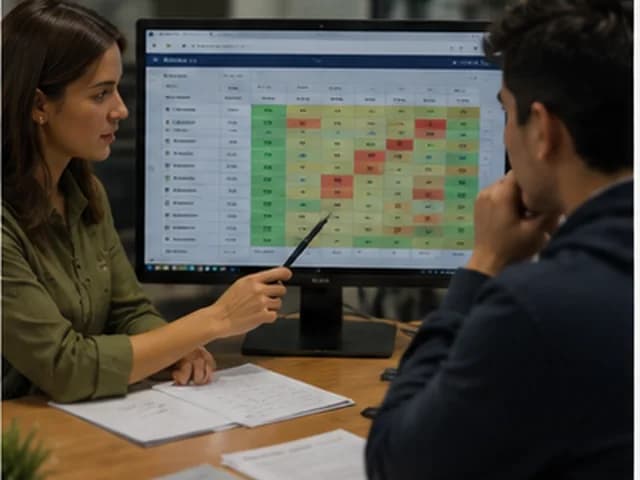
Dropout Risk Prediction
Spot a student pulling away in weeks, while help can still change the outcome.
A student is formally at risk once the attendance shortfall and the backlogs arrive. By then the window has mostly closed. The signs show up months earlier. They sit in four systems that do not talk to each other. Attendance is in one, marks in another, fee status in a third, library and LMS use in a fourth.
A model reads all four together. It flags the student who is moving away from their own past pattern, which matters more than a fixed line. A student whose attendance drops from 95% to 70% is a louder signal than one who has sat at 72% all year. A fixed cut-off treats the two the same.
The flag must reach a mentor with the reasons attached. Not a dean with a list. And you must agree what a flag sets off before you build it. A flag that sets off nothing is a number. It changes no student's week.
Decide before building
- What a flag sets off, and which named person does it
- No student is ever told they are 'high risk' — no labels
- Whether mentors have time for the number of flags you will raise
- How you measure the help given, not just the flag raised

Admissions Automation
Applications sorted and papers checked without three weeks of desk work.
Admissions season brings thousands of forms in a short window. Each one carries mark sheets, certificates and ID proof to check. The work falls to temporary staff under time pressure, and that is where both the errors and the delays come from.
The system reads each document, checks that the details agree, and tests the form against your own eligibility rules. It raises only the real gaps. A clean file moves in minutes rather than days, and that matters in money terms. A student waiting a week for your letter is saying yes to another college.
Notes
- Mark sheet formats vary by board and by year, so test on the real range you get
- Entry rules change each year, so keep them easy to edit and not buried in the code
- Reservation and category rules are policy, applied exactly and never by guesswork
- Keep an audit trail of each entry check the system makes

Automated Essay Scoring
A first pass at marking, with the teacher deciding what the student sees.
Written work is where feedback breaks down under volume. A teacher marking two hundred scripts writes full comments on the first thirty, and the rest get shorter and shorter. That is human, not lazy. It also means most students get less than the task was meant to give them.
The model marks a first pass against your rubric. It drafts notes that point at the work: this claim has no proof, this part skips the question. The teacher then reads the draft, edits it and sends it out. The student gets a comment, not just a mark and a tick.
We would not run this on high-stakes summative marking without a human marker. We say that to each college that asks. Formative work is different. There the point is to improve rather than to certify, so the gain is real and the risk stays small.
Boundaries
- Formative work yes; summative marking needs a human marker
- The teacher edits and sends it; the model never posts a mark by itself
- The rubric must be yours, and the model scores against it line by line
- Watch for bias against non-standard English, which is real and is on record

Student Support Chatbots
Answer the same four hundred questions so staff can answer the difficult ones.
The front desk answers the same questions all year: fee dates, exam dates, hostel rules, how to get a bonafide certificate. Each one is small. There are thousands of them. They all arrive when staff are busiest.
A support assistant answers from your own circulars and handbooks, not from a stock script, and it replies in the languages your students use. It works at ten at night, when the desk is shut and students are looking. What it cannot answer, it passes to the right department with the question already written down.
One design choice matters most: when to hand over to a person. Anything about a grievance, harassment, mental health or money trouble goes to a named person at once, and there is no debate on that rule. A chatbot must never try to hold those conversations.
Escalate immediately on
- Mental health, self-harm or distress — to a named person, always
- Grievance, harassment or discipline matters
- Money trouble at home, which is often the first sign a student will leave
- Anything the assistant is unsure of — it must not guess

Plagiarism & Integrity Checking
Find copied work and flag suspect text, with the evidence a review panel needs.
This work is harder than it was two years ago. Text written by AI matches no source, so a copy check finds nothing. Tools that claim to spot AI writing are far less reliable than their vendors say, and a false charge against a student does real harm.
Our position is simple. These tools give you a signal for a human to review; they never give you a finding. Text that matches a known source is solid evidence. A score saying the text was written by AI is a guess with odds attached. On its own it must never start a discipline case. The job of the system is to put up the work worth a human look, attach the evidence, and state plainly how sure it is.
Be careful here
- AI detection gets it wrong often enough to matter, so treat it as a signal and never as proof
- Writing by non-native English speakers is flagged far more often, and this is on record
- A match to a real source is strong evidence; an AI score is not
- A discipline case must rest on human judgement, and the student must get a hearing

Personalised Learning Paths
Set the order and the level by what a student has shown, not by the calendar.
A cohort moves at one pace. For some students that is too fast, for others too slow, and the gap grows week by week. A student who missed week three struggles in week five, and no one works out why.
Adaptive sequencing sends each student through the material by what they have shown they know. It goes back over a topic they never got, and skips ahead where they clearly did. This works best in subjects with a clear chain of prerequisites, and much less well in subjects built on discussion.
Works well for
- Maths, programming and languages — subjects with a clear order of topics
- Self-paced or blended courses, where the order can really vary
- Less suited to discussion-based humanities, where the cohort is the point
- Needs enough test points to judge mastery, not one exam a term

Timetable Optimisation
Fit rooms, staff and student groups together in hours rather than weeks.
Timetabling is a hard problem. Each term, one or two people solve it by hand over several weeks, and they are the only ones who know how it fits together. The result mostly works, with a few gaps everyone lives with.
An optimiser takes all the limits at once. Room size and equipment. Staff hours and teaching load. Elective clashes across student groups, and walking time between blocks. The real gain is not the first timetable. It is the reruns. A staff member falls ill, or a room is taken. You get a working timetable back in an hour, not in a week.
Needs
- Real room sizes and equipment lists, which the system of record often gets wrong
- Elective numbers as chosen by students, not as planned
- Staff limits stated honestly, including the informal ones people work around
- One person with the power to settle a clash when two limits cannot both hold

Curriculum Gap Analysis
Find the topics that go badly year after year, across cohorts.
Each department has a feel for which topics students struggle with. That feel comes from the students who ask questions, and they are not a fair sample. It also comes from one teacher, in one section, in one year.
Read the marks at topic level, across three or four cohorts and across sections. Three things then come apart. A topic that is truly hard. A section where it was taught poorly. A question that was badly written. That split is where the useful finding sits, and a pass rate hides all three.
Needs assessment tagged by topic
- Question-level marks, not just the total, which is the binding constraint here
- Questions mapped to syllabus topics, which most colleges have never done
- Several cohorts, so a bad year can be told apart from a lasting gap
- Run it as curriculum review, not teacher review, or no one will take part
Where We Specialise
Agents for the Administrative Load
Most of a college office day is chasing, checking and recording. Chase a paper. Check a certificate. Record a payment. Remind a student. It is high-volume work that needs little judgement. It swells for three months of admissions season and never really stops.
The four agents below carry that load. None of them makes an academic call, and none decides where a student stands. Those calls stay with your faculty and your office.
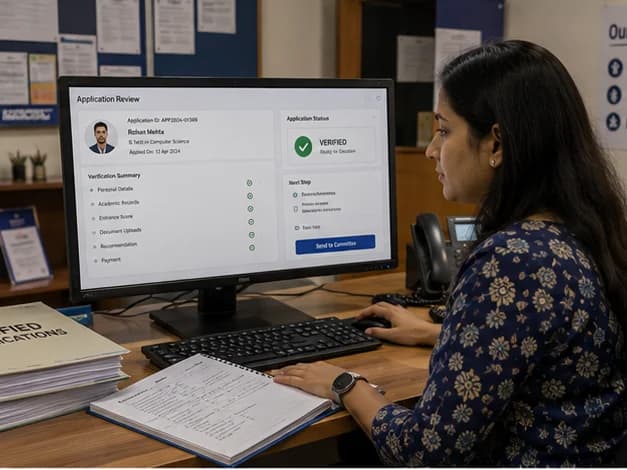
Admissions Processing Agent
Applications checked and chased through the season, day by day, not in batches.
Admissions is a queue that grows faster than it is worked. Forms arrive half filled, papers are missing, and students need chasing. And each day a student waits is a day another college can win them.
The agent works on each form as it arrives. It reads and checks the documents, and tests them against your eligibility rules. It marks what is missing and asks the student for it. Complete files reach the admissions committee ready to decide. The rest are chased without anyone having to remember.
Who gets admitted is your decision, always. The agent only takes away the checking and the chasing, which is where the weeks go.
What it handles
- Reads mark sheets and certificates, and checks that they agree with each other
- Entry rules checked, and easy to edit when they change each year
- Follow-up with students for the papers they have not sent
- Category and reservation rules applied exactly as your policy states
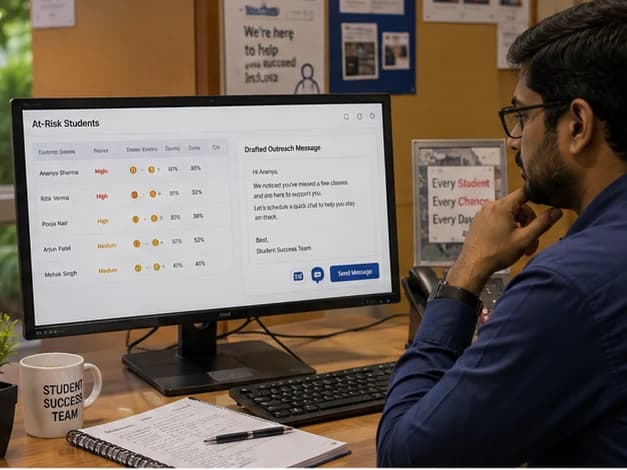
Student Outreach Agent
The check-in for students no one has the time to check in on.
A mentor is given more students than one person can know well. The students who get attention are the ones who ask for it, and they are rarely the students most at risk.
The agent keeps in touch where a person cannot. It sends reminders about dates and papers due, and checks in with students whose pattern has shifted. It collects short answers to simple questions. What reaches the mentor is a small list of students who need a real talk, with the reason attached.
The limits are firm. It never talks about marks or standing, and it never carries bad news. Any sign of distress goes to a person at once. It opens the door for a human conversation. It does not have that conversation itself.
Hard boundaries
- It never talks about marks, standing or discipline matters
- Any sign of distress goes to a named person at once
- Students are told plainly that this is an automated check-in
- A cap on how often it writes, because daily contact from a college is pressure and not support

Assessment Feedback Agent
Draft feedback ready for each script, for the teacher to edit and send.
Feedback gets thinner as the pile grows, and the students marked last get the least. That is not a failing of teachers. It is arithmetic.
The agent drafts feedback against your rubric as each script arrives, naming what the student covered and what they missed. The teacher works through a queue of drafts, edits, and sends. That takes a fraction of the time of writing each one from scratch. It also holds the same standard across the whole cohort, instead of dropping down the pile.
No mark reaches a student until a teacher sends it. The agent drafts. The teacher teaches.
Design rules
- Nothing reaches a student until a teacher sends it
- Feedback points at the rubric line by line, so anyone can check it
- Watch for bias against non-standard English, in the wording and in the marks
- Editing a draft must be faster than writing one, or teachers will drop it
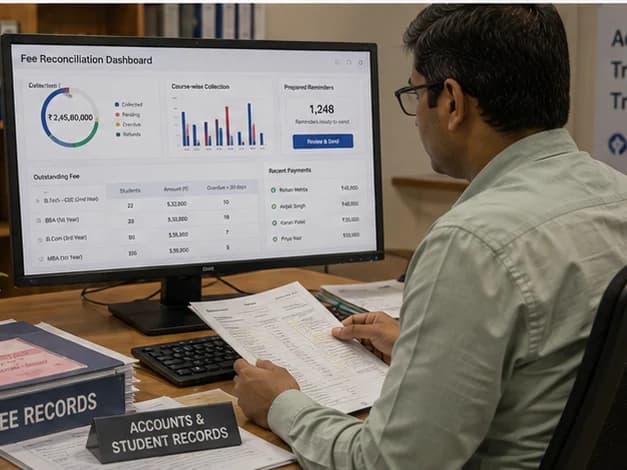
Fee & Records Agent
Fees matched and reminders sent, with hardship read as a signal, not a default.
Fee follow-up is constant, awkward and never finished. Handled badly, it also loses you the student who meant to pay and needed a fortnight.
The agent matches payments to records, and sends reminders on the channel the family uses. It shares a payment link. It issues the records and certificates students ask for, with no trip to the office. When a payment is late two or three times, it raises a flag. That flag does not go to collections. It goes to student welfare, because a late fee is often a sign of something at home.
That routing is deliberate. A late fee is often the first sign of a family circumstance that ends with the student leaving. Treat it as debt collection alone and you lose students the college could have kept.
Handled with care
- Repeated delay goes to student welfare, not only to accounts
- The tone stays kind — this is a family under strain, not a debtor
- Records and certificates sent out without a trip to the office
- Marks and results are never blocked over a fee
Sequencing
Where to Start
Ordered by how fast you see something you can act on. And by how much governance each one needs first.
| Use case | Data usually ready? | Time to result | Governance needed |
|---|---|---|---|
| Student Support Assistant | Yes — circulars and handbooks | 4–6 weeks | Low — escalation rules |
| Admissions Automation | Yes — application records | 6–10 weeks | Low — audit trail |
| Fee & Records Agent | Yes — finance system | 6–8 weeks | Low — tone and routing |
| Timetable Optimisation | Needs accurate room data | 8–12 weeks | Low |
| Dropout Risk Prediction | Scattered across systems | 3–4 months | High — intervention and labelling |
| Assessment Feedback | Needs rubrics digitised | 3–4 months | High — academic governance |
Being Straight About It
Worth doing if
- Colleges where attendance, marks and fees sit in systems that do not talk to each other
- Colleges where one mentor holds far more students than one person can know
- Colleges where admissions season buries the office each year
- Leaders who will decide, in writing, what an at-risk flag sets off
Probably not, if
- Anyone who wants to hand high-stakes summative marking to a machine
- Anyone who wants to use AI detection as proof of cheating
- Colleges with no one free to act on the flags — a flag alone changes nothing
- Places where no leader will own how student data is handled
FAQ
Questions Colleges Ask Us
It is right to find students who need help sooner than you find them now. It is not right to label them. Do not tell a student they are high-risk. Do not let a score follow them through their record. The difference sits in the design. The flag reaches a mentor as a prompt to check in. It never reaches the student as a label, and it never sits in a file as a rating. We build it that way. We would say no to building it the other way.
Yes. And we would advise being open about it, not just doing the minimum the law asks. Tell students what data you use and what you use it for. Put it in the handbook, in plain words. A college that studies its students quietly and is found out later loses their trust for years. Under DPDP, the duty to be open about children's data is not one to read narrowly.
Not reliably. Anyone who says otherwise is overselling. These tools get it wrong often enough to matter. They also flag writing by non-native English speakers far more often, which in an Indian college means flagging students unfairly. We run them as a signal for a human to review, never as proof. A discipline case built on a detector's output will not survive a challenge. Nor should it.
No. And the question itself is worth pushing back on. What changes is where a teacher's hours go. Less first-pass marking, less chasing of paperwork. More teaching, and more time with the students who need it. The feedback agent exists so the two hundredth script gets the same care as the first. That is about consistency, not about cutting headcount.
No, it is the normal starting point. Joining those systems is usually the first four to six weeks of work. The join is also where much of the value sits. Dropout risk is invisible in one system alone and fairly clear across all four. Budget for that integration honestly, rather than calling it setup. And expect matching student identity across systems to be messier than it looks.
Risk models and timetable work are cheap to run. They run now and then, on modest hardware. The support assistant and the agents use a large language model. Those carry a cost per question, and that cost rises with student numbers and with the season. Admissions season will cost several times a quiet month. Model the peak rather than the average, because the peak is what you have to fund.
Yes, and in most Indian colleges it should. Students ask in the language they are at ease in. That is often not English, and it is often a mix of two. It works best in English and Hindi, and less well in other languages. So state which languages it handles well. Route the rest to a person at once. A half-right answer in a language it half-knows is worse than no answer.
Ground it in your own circulars and handbooks. It must not answer from general knowledge. It must say it does not know rather than guess. We also keep a log of what it was asked and what it said. Read that log weekly at first. It shows you the questions your own documents answer badly. A wrong answer about a fee date does real harm to a student.
Then the rules tighten, and you should treat them as design requirements. DPDP sets out specific duties on children's data, including checked parental consent. Watching how a minor behaves deserves a higher bar than we would set for adults. Several of these use cases still fit a school: admissions, timetabling, fee work. Others we would approach much more slowly, with a lawyer involved early.
Your data is yours, and you can export it at any time. You get the working system, the documentation and training, so your team can run it day to day. What else transfers at the end of a project — model files, source, licence terms — is set out in the contract before work starts. We would also urge you to set a retention policy for this data. There is rarely a good reason to hold behaviour data on a student who left four years ago.
The support assistant, four to six weeks. Admissions work, six to ten weeks, timed to be ready before the season starts. Dropout risk, three to four months. Much of that is joining systems and agreeing what a flag sets off. Assessment feedback runs about the same. Most of that time goes on the review screen, because if editing is slower than rewriting, teachers will not use it.
It will, if you raise more flags than they can act on. That is a real failure mode, and we design against it. Mentor time should set the number of flags, not a statistical cut-off. If a mentor can hold five real conversations a week, the system should surface the five students who need them most. A list of forty names handed to someone with time for five helps no one.
Yes, but only in an indirect way. Keeping students, better feedback and curriculum review all feed NAAC and NBA criteria. Hard evidence beats a claim in a self-study report. What it will not do is manufacture an outcome. If the teaching or the labs and equipment are the problem, better data will show that clearly. It will not fix it.
Then we say so. Sometimes the systems cannot be joined without a project you are not ready for. Sometimes no one has the time to act on what a model would find. Then the flags go into a void. We would rather stop early than hand you a dashboard no one has the staff to use.
Recognise your plant in any of that?
Tell us which problem is costing you most and we will tell you honestly whether it is worth building, what data it needs, and roughly what it costs.
Book a Free ConsultationSee our Education solutions